

Mars Revisited, pt. 3
Spirit at Husband Hill
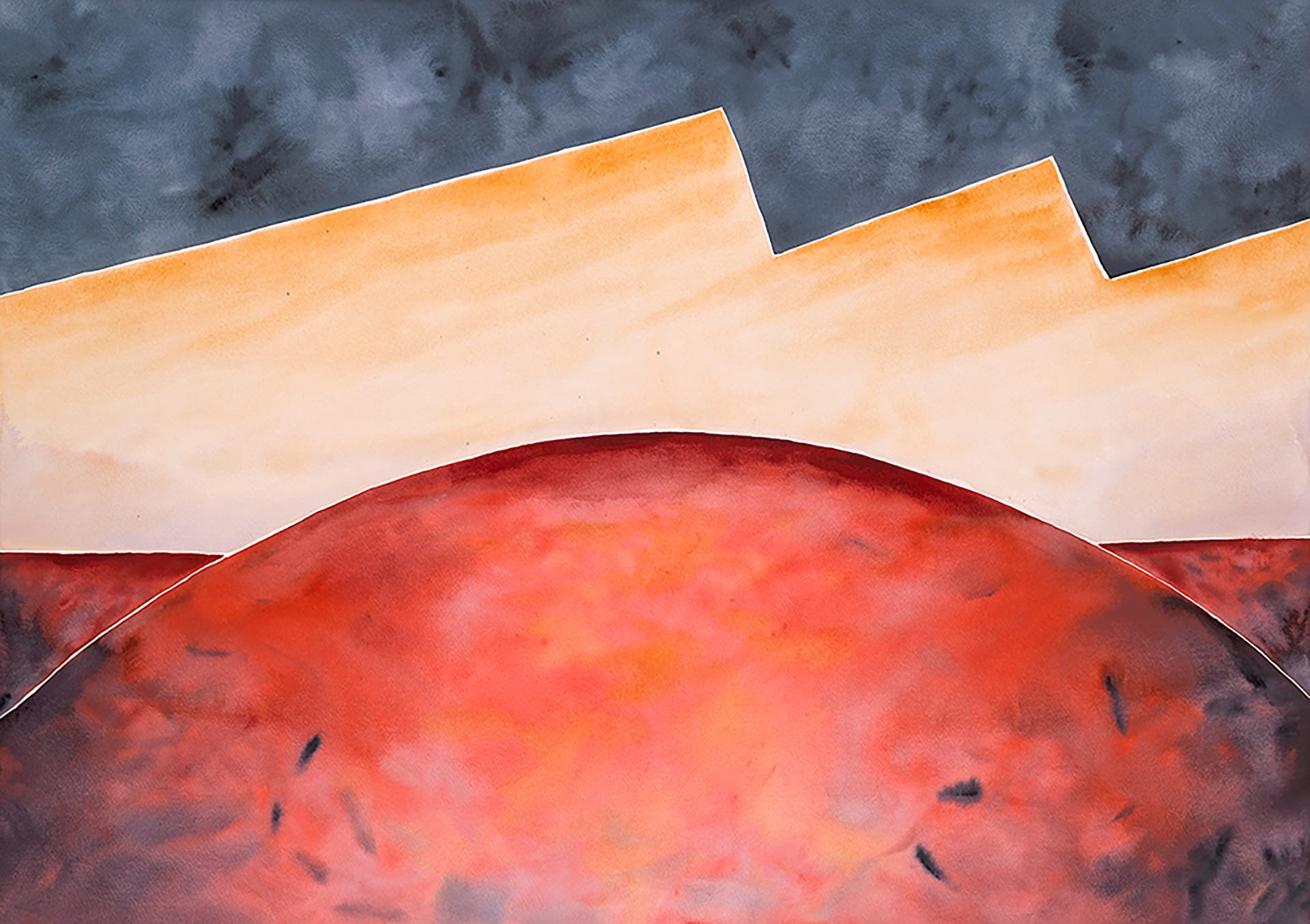
Spirit at Husband Hill 2018 | watercolor on paper | 39.25" x 27.25"
When I started the series Mars Revisited in 2017, I was tired, wiped out. I wanted to immerse myself in something engaging that also would help me regulate my nervous system (more about this in my first post from this series). I find myself in a similar place. The past six weeks have been a hopscotch game from one physical condition/illness to another, world events aside, and I’m in rest and recovery mode as I write this.
The series was focused more on technical painting aspects and formalism than any of my other work. The landscapes are obviously a traditional subject matter, even if landscapes are usually scenes from Earth. There are people who love these paintings (and have purchased some of them), and there are people who love to tell me how trivial they are. Maybe it’s landscapes in general, the subject matter of Mars (lots of opinions about NASA and space exploration out there), the focus on formalism, getting lost in the paint as a painter, or all of the above… those are all elements some feel are worthy of derision, and the fact that I created them must mean I am worthy of receiving that blunt derision.
But you know how the saying goes… Fuck ‘em.
I love these paintings. They were satisfying to me at the time I made them, and they are satisfying to me now. To me the focus on the technical and on formalism mirrors the subject matter. It’s a no monkey business approach. Just the facts, ma’am. Retired astronaut Chris Hadfield has said:
Astronauts don’t want adrenaline in their veins. You don’t want to be thrilled by what’s happening. You don’t want to be overwhelmed by what’s happening. You want to be calm, and cold, and calculating, and aware, and competent. Like if you get on to an airliner and you're about to take off and you're a passenger and you lean forward and you see the crew up there, you don't want them to be up there like high fiving each other and cheering, or you don't want them to look all terrified sitting up front. What you're looking for is people who have practiced and who understand it and no matter what happens they are calm and ready and competent. You don't want someone who's up there supercharged and going, “Watch this!” with the airplane. You want the commander of your airplane to be as ready and capable of flying that ship as possible. For the astronauts, we have to take it to a whole other level.
The stakes are high in space, and there is not a lot of room for error. Sloppiness and a lack of focus can lead to death in an instant. And while mission failures and even the risk of catastrophic outcomes are a part of the territory, and a part of learning, a respect for the gravity of potential outcomes is critical. Taking the job seriously, minimizing unnecessary risks, and doing due diligence are the mark of good leadership and good stewardship.
At the time I was working on this series, Elon Musk launched a Tesla into space, the very demonstration of egoic, “Watch this!” (or maybe even more so: “Hold my beer and check this shit out!”). I was regularly attending Astronomy on Tap in Austin, a meetup of astronomers, astrophysicists, and people like me who just had a keen interest, where different speakers took turns sharing their areas of expertise every month. The event was a huge topic of conversation, and people were appalled. Sending a non-sterile object into space, without the due diligence of charting a specific trajectory to ensure it would not someday impact Mars, other celestial bodies, or even eventually Earth, was a level of callous sloppiness that was seen as inexcusable. Fast forward to 2025, and well, it’s still a relevant topic for what I hope are obvious reasons.
As funding is cut across every governmental body in the U.S. and toadies are put into leadership roles, it might be easy to overlook to importance of integrity within space exploration as “non-essential.” But as more and more control is handed over to an unstable man who feels entitled to do whatever amuses him, eff the consequences, we should be concerned. We should be paying attention. Personally, I don’t want to see a future where we trash the solar system by exploiting it for rare minerals, contaminate it with bacteria, or repeat the mistakes we have made here on Earth. As with the many cautionary stories told through literature and film about authoritarianism that we are now seeing play out on the actual world stage, there are an equal amount of cautionary tales about a potential, very dark, reality of human expansion into space. Along with the other stories, it would be to our benefit not to dismiss them but to take them to heart.
None of those concerns are explicit in the paintings, but they were in my heard and in my heart as I painted them. This was not about flashiness. It was not about conceptualism. It was about calm. It was about revisiting technique, revisiting formalism, practicing. Continuing to return to the basics is a part of the practice. It is due diligence. The academic “rigor” (if you want to use that word, though, 25 years in a corporate environment has made me hate it and everything it stands for), plays out in that return to the fundamentals and through the emphasis on continually honing skills, and not through emphasizing intellectualism. To me, that’s there, but it’s in the background. And it’s okay to me if others don’t see it, instead seeing only the surface elements (or succumbing to biases against space exploration or landscapes in general). These were paintings I created purely for myself and my personal practice, art world expectations be damned. And so with all of that loosely in mind, I just went straight into in a way I honestly had not ever allowed myself to, even back in art school.
This painting in particular reflects that most clearly to me. The composition was purposely reductive, taking elements from an image taken by the Spirit rover and converting them to shape:
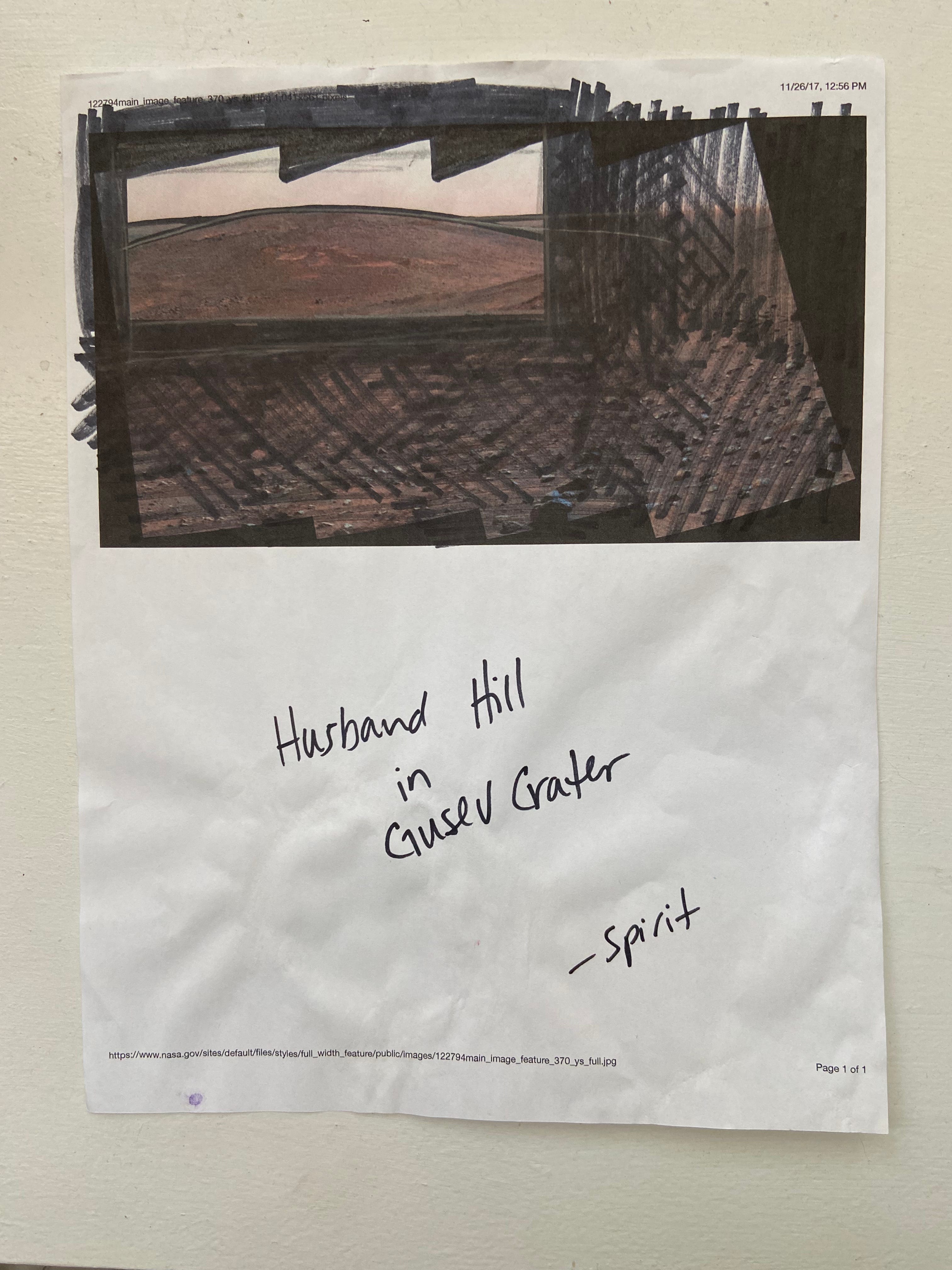
Composition study for Spirit at Husband Hill
Composite imagery compiled from multiple images resulted in a distinctive jagged edges on many of the photos from the rovers, and I honored that in this painting by including the grey negative space at the top. This image below, taken by Spirit as it descended Husband Hill, shows that better than my sketch above (since I covered it with marker). This is a 360-degree panorama created from 405 individual photos:

“Descent from Husband Hill,” taken by the Spirit rover in 2005. Image credit: NASA/JPL-Caltech/Cornell
As with the other paintings in this series, the title is derived from the rover that took the image I worked from plus the location. Husband Hill is one of the tallest peaks in the Gusev Crater. Spirit took about a year to climb to the summit, the first ascent of a hill on another planet. From the top, we were provided a vista, a place to get our bearings, pause, look around, and reflect. The site ended up providing significant information about Mars’s past wet conditions, some of our first hard evidence of that fact, and is notable for that reason. But I chose this location to work with because of its namesake.
Rick Husband was the commander of the space shuttle Columbia, which exploded during reentry in 2003 due to a defect in the foam insulation that comprised the heat shield. To my knowledge, the fact that a rover named Spirit (as opposed to Opportunity) visited a site named in memory was not intentional, but there was a certain poetry to it that struck me. The loss of life of seven astronauts that day was deemed a result of “managerial and technical shortcomings” and led to changes in safety measures and inspection procedures. It was a tragic result, but not one that resulted from outright carelessness. Whatever anyone’s views on consciousness and “spirit” are, the event is like that moment of pause on the summit, where we can look around and ask ourselves what is the spirit with which we move forward.
It’s an important reflection, one with real consequences and potentials. And the other part of this work for me—outside of technique and formalism—was reverence, a reverence for the significance of taking in the view from a hilltop on another planet, for the universe, for our place in it and as part of it. And that’s where the “getting lost in the paint” aspect came in for me. This was, at its essence, an exercise in establishing calm. The meditative process of shepherding wet paint on a wet surface, allowing it to take on a life of its own while nudging it gently in the direction I wanted it to go, that got me there.
This morning, I posted the accompanying video for this post on YouTube, and I rewatched the two minute video I had created, and that got me there too. It was what I needed in the moment at a time my body needs to reset: a short, moment of pause, appreciating where we have been and those who came before us, and choosing mindfully how to move forward, honoring those who will come after us.
While working on new things that aren’t ready to be put into the world, I’m sharing some old work from my Mars Revisited series both here and on YouTube.
More from this series:
Check out all the paintings from my Mars Revisited series on my portfolio site.
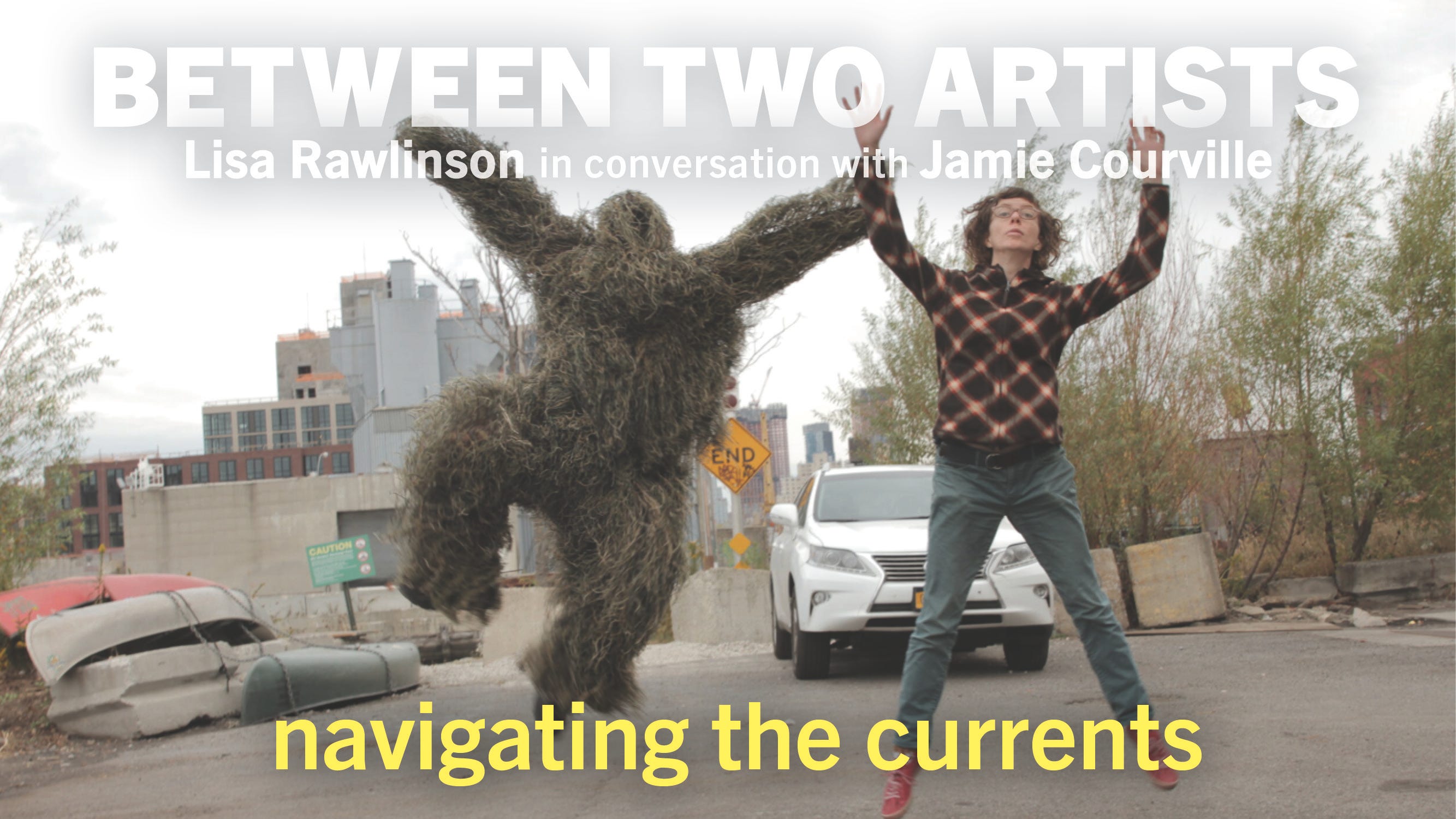
Recently I recorded an artist talk with Brooklyn-based independent filmmaker and artist Jamie Courville. In it we discuss her new documentary, “Gowanus Current,” which explores the essential question what is of value, and who gets to decide? I mentioned that the question had relevance to every part of this planet right now, but I want to amend that by saying it also applies beyond this planet. Watch the talk on You Tube, right here.
This Writing Force Within is an exploration in creativity and living from artist and writer Lisa Rawlinson.
This post is free, but if you’d like to support my work, one-time donations are appreciated. Thanks for looking and reading!