

Mars Revisited, pt. 2
Mystery in Horowitz Crater
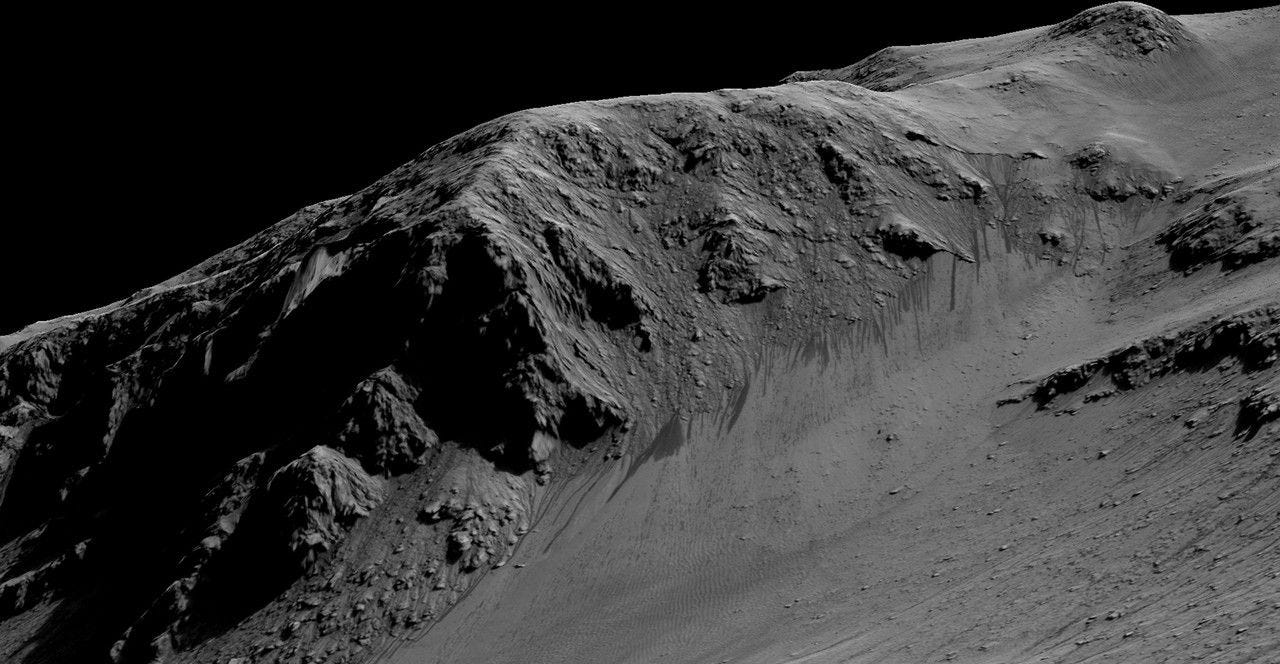
Processed view of Horowitz Crater, Mars, created using data from NASA's Mars Reconnaissance Orbiter. Image credit: NASA/JPL-Caltech/Univ. Of Arizona
Ever think about what things could be like if we as a species weren’t so busy killing and exploiting each other in unconscious wound-responses or fear- and greed-driven power grabs? Me too.
There is enough to go around. Enough of what we need to get by. Enough of what we need in order to support ourselves while we do the things that we would like to do, both what we have imagined and what we cannot yet imagine. Enough for everyone to be safe, secure, and to thrive.
I think about that often. More and more so these days.
For a species that is smart enough to travel to other planets, to discern the existence of quantum properties, and to map DNA, we sure have some gaping blind spots when it comes to our own personal and collective human behavior.
The question of whether or not we will drive ourselves (and many other living things) to extinction or wise the F up before it’s too late looms large these days. Whether through war, human-driven climate change, diseases that should be controllable, or a combination of any of these things and more, the tipping point is ever more imaginable by the day.
I want to believe—because I want it to be true—that human beings are capable of getting their shit together, and I wonder what it will take to get us there. Change does not come from a comfortable status quo. Sometimes we have to have the rug yanked out from under us in some form or fashion to jostle us into seeing things a new way, into realizing we are up against a wall and it’s either change or be crushed under the wheel of fortune. So, what is that thing? Because there has been dramatic event after dramatic event after dramatic event that we are all seeing much more clearly than any time ever in history thanks to technology, and if you are like me, you find yourself in a repeating chorus of “It should have never gone past __________.” (Fill in the blank with any horror you like.)
I feel like in some areas of my life I got there a long time ago, like in my publishing career when I was doing all the things and getting promoted and working insane hours and still was unable to get by because hey, maybe somebody would decide not to pay me until I threatened legal action, or maybe a project I’d contractually obligated myself to would keep getting pushed and pushed until all of a sudden months have passed and no income is coming in but a non-compete form has kept me from getting other work. Shit like that. In other areas—like the nitty gritty interpersonal relations and childhood BS that gets so ingrained you don’t even know it’s there—I’m still working on it. But I try to keep this question: “what does it take?” at the forefront of my mind. If I want to live in a world where peace between all people is possible, that means I have to allow for the possibility in my own life, right? And what does peace with people who may have hurt us in the past look like? What if they are ideologically opposed to some element of our existence like gender, sexuality, skin color, or core values? If we want peace to be possible between nations that have been at war with each other, can we mirror that and make it a reality on smaller scales?
I do know that if a peaceful world is possible, it means we have to reckon with all of those divisions, whether they are geopolitical, ideological, ancestral, familial, cultural, subconscious, glaringly obvious, collective, or personal. We don’t have to go to dinner parties with people we don’t want to sit at the table with, but we do have to learn how to live together and to share the abundantly available resources on this planet. I don’t have answers to these questions. I don’t know how we accomplish this. I just know it’s a bee in my bonnet, and a pressing one.
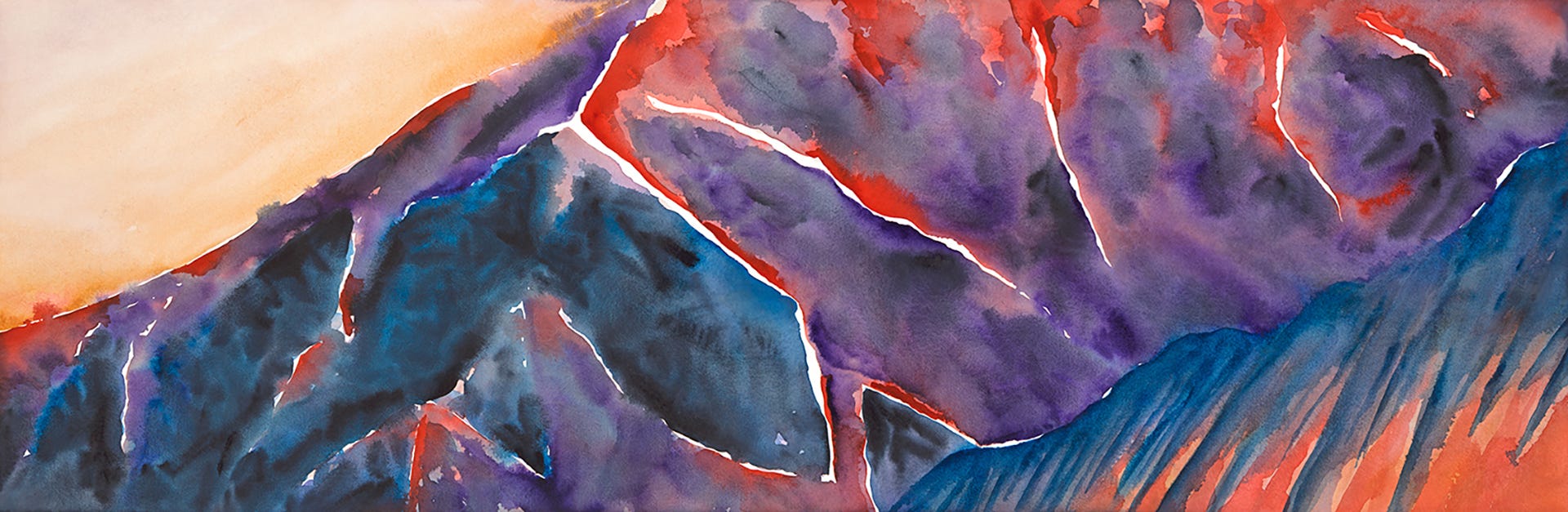
Mystery in Horowitz Crater 2018 | watercolor on paper | 39.25" x 12.75"
Meanwhile on Mars, there are these dark streaks that appear in the warmer part of the year and then fade away during the colder season. Called Recurring Slope Linea (RSL), they mostly appear on the steep walls of canyons at latitudes closer to the equator. Since they were identified in 2011, they been a bit of an exciting mystery. To start, it was thought they potentially indicated liquid water on Mars, and at the time evidence of water was still scarce. Spectrometry from the Mars Reconnaissance Orbiter did not detect water, but it did detect salts that were thought could have been residue from briny liquid water that evaporated rapidly when it rose to the surface. Later, other hypotheses emerged, including that the streaks are dry granular flows (so, essentially sand), but the cause of their seasonal movement couldn’t be explained. Additional research has shown dust devil trails crossing the areas where RSL appear, suggesting the movement could be triggered by weather events. But, we don’t know. It’s still in question.
And in all likeliness that answer will come to us through discovery, research, and good ol’ human brainwork (AI could definitely help in a beneficial way here though), and it will come before we find answers to those other questions. But I haven’t given up hope just yet.
While working on new things that aren’t ready to be put into the world, I’m sharing some old work from my Mars Revisited series both here and on YouTube.
More from this series:
Watch the accompanying video for this post on YouTube, here.
Check out all the paintings from my Mars Revisited series on my portfolio site.
This Writing Force Within is an exploration in creativity and living from artist and writer Lisa Rawlinson.
This post is free, but if you’d like to support my work, one-time donations are appreciated. Thanks for looking and reading!